
- AI for SMEs Value, Risk and Control
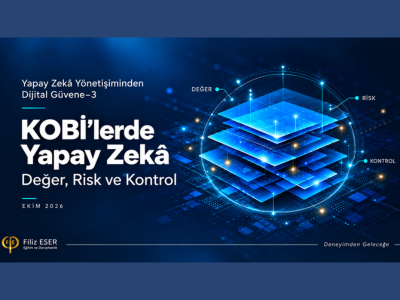
AI for SMEs: Value, Risk and Control
From AI Governance to Digital Trust–3
Filiz Eser | October 2026
Artificial intelligence can help small and medium-sized enterprises (SMEs) save time on tasks such as preparing quotations, reviewing customer requirements and analysing technical documents. Turning these time savings into better business performance depends on choosing the right use case, assessing the risks and embedding appropriate controls into everyday processes.
Producing a draft in a few minutes does not necessarily mean the entire task has become more efficient. The effort required to check the output, fill in gaps and correct errors must also be considered.
This brings us to a fundamental question:
Where are we using AI, what benefit do we expect, and what controls are in place?
In this article, I explore AI adoption through value, risk and control, with a practical quotation preparation example and a seven-question checklist for SME owners and managers.
Where Can AI Create Value for SMEs?
Before introducing AI, we need to define the task we want to improve.
Are quotations taking too long to prepare? Are customer requirements being misunderstood or overlooked? Is the same information being entered repeatedly into different files? Does reviewing technical documentation take too much time?
Once the problem is clear, AI’s contribution becomes easier to assess.
For example, when evaluating quotation preparation, we should consider the time needed to produce the first draft alongside:
Time spent checking and correcting it,
Rework caused by missing or inaccurate information,
The accuracy and timely completion of the quotation sent to the customer.
The real gain is reaching an accurate, usable result with less total effort.
The OECD’s Generative AI and the SME Workforce, published in 2025, draws on a survey of more than 5,000 SMEs across seven countries conducted in late 2024. It examines generative AI use alongside productivity, workforce skills and business preparedness. Türkiye was not included in the sample, so this scope should be considered when interpreting the findings for Turkish SMEs.
My recommendation is to start with one use case and measure the current process. Without a baseline, it becomes difficult to determine how much of an improvement can be attributed to AI.
What Risks Should SMEs Assess When Using AI?
Different AI applications have different consequences for a business.
An omission in an internal meeting summary may have a very different impact from an incorrect specification in a technical quotation sent to a customer. The level of control should reflect how the output will be used and the potential consequences of an error.
Three questions provide a useful starting point.
1. Data: What Information Are We Sharing?
Are we entering sensitive customer, employee or business information into the tool? Are its data handling terms consistent with the company’s information security rules?
2. Output: What Could an Incorrect Result Cause?
Could inaccurate or incomplete information lead to additional costs, delays, production errors or a loss of customer trust?
3. Authority: What Actions Can the AI Take?
Does the AI only prepare drafts, or can it modify records, initiate transactions or send information outside the organisation?
When tools are authorised to take action, the need for control expands. We should define permitted actions and their limits, when human approval is required, and how the tool’s operation can be stopped.
The NIST AI Risk Management Framework addresses understanding AI’s limitations and defining human oversight processes. For an SME, the practical question is:
Which outputs can we use, under what conditions, and where is expert verification required?
How Can SMEs Establish AI Governance?
AI governance involves defining and monitoring decisions about the purpose of AI use, responsibilities, limits of authority and controls.
Controls should be clear enough for employees to apply and proportionate to the risks involved. For each use case, the following decisions should be explicit:
Who is accountable for the task and its outcome?
Which tools and data sources may be used?
What information may be shared?
Who verifies the output, and against which criteria?
When should use be stopped, and to whom should the issue be escalated?
ISO/IEC 42001 provides requirements and guidance for establishing, implementing, maintaining and continually improving an AI management system within an organisation.
To put this approach into practice at SME level, we can integrate AI use into existing quotation, sales, production or quality processes. This allows purpose, responsibility and results to be managed within the same workflow.
This principle also underpins my Minimum Viable Management System (MVMS) approach for SMEs:
A lean system. Clear control. Higher productivity.
A Practical Example: Using AI to Prepare Quotations
Consider a manufacturing SME using AI to prepare draft quotations from customer enquiries. The following is an illustrative scenario.
Value objective: Reduce quotation preparation time and avoid overlooking customer requirements.
Main risks: Adding a technical feature that the customer did not request, using outdated prices or proposing an unsuitable delivery date.
Controls: Drafts are prepared using current, approved product information. Missing or uncertain information is flagged rather than guessed. Authorised staff verify technical compliance, pricing and delivery terms. The quotation is sent to the customer only after human approval.
Monitoring: Preparation and checking times are measured together. Corrections resulting from inaccurate or incomplete information are recorded.
These records support the next management decision: should the business expand the use case, update its data or strengthen its controls?
Digital Trust: Showing That Controls Work
Here, I approach digital trust as understanding the conditions under which we can rely on technology’s results—and being able to demonstrate the basis for that confidence.
Saying “we check the outputs” is a starting point. Confidence becomes stronger when we can show who performed the checks, which criteria they used and how identified errors were addressed.
In the quotation example, supporting evidence might include the version of the product information used, approval records, reasons for corrections and process measurements. The extent of record-keeping should reflect the risks involved and the business’s information security needs.
Creating sustainable value from AI requires measuring the benefits and making accountability visible.
An AI Checklist for Your Business: Seven Questions
Choose one task in which your business uses AI and review these questions together:
-
Purpose: Have we clearly defined the task we want to improve and the benefit we expect?
-
Measurement: Are we measuring the gains, including the effort required for checking and corrections?
-
Data: Have we defined which tools may be used and what information may be shared?
-
Risk: Have we assessed who could be affected by an incorrect output and how?
-
Accountability: Have we identified who verifies the result and which actions require approval?
-
Intervention: Do we know what to do when an error or unexpected action occurs?
-
Evidence: Do we have measurements and records showing that our controls work?
These questions are intended to support an initial practical discussion. They do not constitute a comprehensive assessment of conformity with a standard.
Rather than starting by assigning a score to each answer, look for a concrete example that supports it. A question you cannot support with an example may reveal a priority for improvement.
For a task you have accelerated with AI, can your business clearly answer these three questions?
What value are we creating? What risk are we taking? What controls give us confidence?
Take the First Step in Your Business
Explore ISO/IEC 42001 training and Minimum Viable Management System consultancy for SMEs to assess your AI use alongside your processes, responsibilities and risk management.
Explore training and consultancy services
For further articles on AI governance, process improvement and digital trust, subscribe to my LinkedIn newsletter, “IT Analist – Verimlilik için Dönüşüm!”
Subscribe to the LinkedIn newsletter
Sources
OECD — Generative AI and the SME Workforce: New Survey Evidence (2025)
- Contact
Our expertise in our relationships and in our training is our ilk. If you get in touch with us, we can decide together how we can help you and how we can contribute. You can contact us for your immediate needs or your long-term goals.
Address
Ankara / TURKEY